
 Mutuo
Foreword
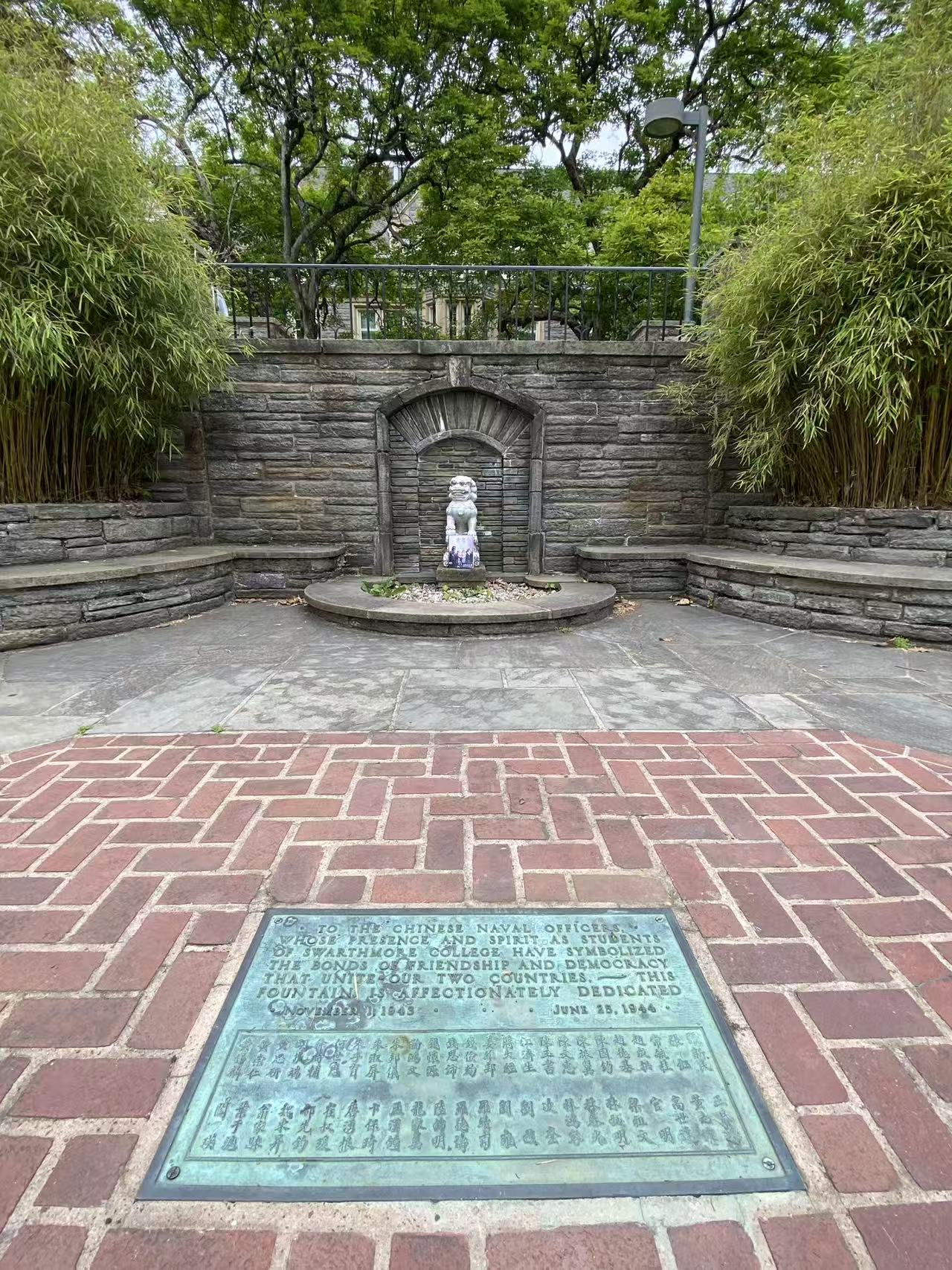
Eighty years ago, forty-nine naval officers from across China came to Swarthmore College to study engineering, mathematical subjects, and the English language. Swarthmore College was chosen as one of the few colleges to participate in the U.S. Navy’s V-5 and V-12 programs. The aim of the programs was to train engineers, aviation candidates and premedical students during World War II. Former U.S. Navy Commander Henry T. Jarrell recalled that ‘the competition of the privilege of having the Chinese was quite keen, and in the end Swarthmore College was chosen because of its friendliness.’ Upon the Chinese officers’ participation in the 1944 Commencement ceremony, a fountain was unveiled in their honor before Wharton Hall with the following words inscribed:
“To the Chinese naval officers, whose presence and spirit as students of Swarthmore College have symbolized the bonds of friendship and democracy that unite our two countries — : this fountain is affectionately dedicated.”
June 25, 1944
It was during senior week two years ago that I first heard about the stories of the Chinese Naval Officers. A friend among the graduating class told me the time he stumbled upon the fountain dedicated to the Chinese Naval officers and their archival records while working in the College’s special collection. I was intrigued and remembered that such an establishment does indeed exist in front of Wharton Hall. I decided to visit the site soon after our brief exchange.
The monument is situated right in front of Wharton Hall. The fountain has been defunct for a while and the only thing that remains is the sculpture of a white lion, exquisitely crafted. White lions are marks of strength and prosperity in Han Chinese culture, and they are often seen in front of households. Next to these two lions is an inscription, the one that I recounted above just now. Upon seeing this, it came to my attention that I had been here many a time, but it was not until then that I took proper notice of the traditional Chinese characters engraved upon the cold, metal plaque with each denoting the name of an officer. Crouching down, I read aloud all their names to myself in Mandarin.
A few days later I found pictures of these officers on the internet. I began to match faces one-by-one with the names written on the plaque. In these photos, they were marching outside of what is now the College’s fieldhouse in a morning drill. Some looked stern, many joyful, but all bear a somewhat alien quality to me. Staring at those faces, what I felt in that moment I cannot quite articulate. I remember that my pulse was racing slightly and that my cheeks were warm. Who are these people? I asked myself. My mind suddenly jumped back to a conversation that I shared with a group of classmates a year ago, all of whom were Americans. We were talking about vacation destinations on our bucket list, and they suggested that it would be easier for me to go to Russia and North Korea, since they were my allies but not theirs. I wasn’t sure how to take this. There’s some truth in it, I guess, but I still felt a sense of bafflement. Who’s ally am I? I was waiting for “enemy” to appear, but the conversation was cut off and the word was left hanging in the air like an elephant in the room.
That exchange made its way back to me later on in that sweltering summer of ‘24 in China, at home, nauseously. As I roamed around the narrow alleys of centre city Beijing and later in the open streets of western Sichuanese towns, what started as a conversation on the other side of the pacific, from afar, became, simply put, personal. Looking around, the implausibility but also the mere possibility of a willful ignorance en masse haunted me. Could it be that the old man who runs the bike repair stall next to my house cares about the Russians so deeply? Or could the woman who works in the local breakfast chain hate the American people down to their marrows so as to go into battles as their enemies in the event of war? My stomach churned and I took a second to let that thought settle down. “And what about me? Who am I to hate? Who am I to love?”
The oxymoron of the questions above lies in the seemingly irreconcilable antithesis between the duality of Love and Hate, which are emotions indispensable from human intimacy and passion, and the constructed image of an intangible, dehumanised throng against whom they are asked to lash themselves upon. This is the very paradox, the very agony, which we as individuals, as wielders of Love and Hate, must battle with every day. How to bear this agony, thus, becomes a question deserving utmost attention.
From time to time, I find myself repeatedly seeking refuge and truth in the various forms of story-tellings. We continue to live in a world full of oral traditions. What this means is that tales — accrued and passed down by generations of narrators — lives on in every one of us and continues to be a major provenance of how history is understood. It is a source that nourishes itself from the spectacles of the individual, which, as much as some wish to deny, are the basis of all historical contexts. For me, it was the family legends that my younger self consumed on those long-winded road trips to Dongbei (or Manchuria) that informs me of who I am till this day.
Reflecting on my own lineage today, most memories about my ancestry I cannot quite fully recount, though a few did manage to stick around. There was a story about how a great-aunt on my maternal side disappeared at the end of the Chinese Civil War. My maternal family comes from Greater Beijing. She married a Nationalist officer and ran away with him at the end of the war. She managed to flee out of Beijing, but what happens after that remains an enigma. Mother seems to believe that she died somewhere in the South before she was able to make it out of the mainland, and that it was perhaps for the best. She said that she got her source from a distant relative who happened to visit her house in Miyun, the northeast suburb of Beijing, once in the mid-80s. I wonder if this woman whom I’ve never seen but to whom I am related by blood is still alive? And if so, where would she be today? How did she lead her life after the war? If she fled to Taiwan, would she be Taiwanese? How would that change our perceptions of her?
The other story about my ancestry that stood out was the siege of Changchun in 1948, the city my father came from. During the siege, the Communists were starving the Nationalist soldiers in the city in the hope of a quick surrender. Chiang Kai-shek was airdropping supplies but it was shambolic. There was not enough food for an overcrowded city and everything was grabbed by the soldiers. The story goes that my paternal great-aunt married a Nationalist sergeant so that the family could have enough to eat. The marriage was symbolic, of course, and a divorce soon followed for both of their good when the Nationalists pulled out. They never saw the sergeant again.
My thoughts returned to the plaque in front of Wharton. What happened to the fate of the forty-nine officers? According to the files available online, it says that these naval officers either disappeared during the Chinese Civil War or escaped to the U.S. after the Communist claimed victory.
The files online were limited, so I booked an appointment at the start of Fall 2025 with the College’s special collection to see the rest of the records of the Naval Officers. I came across a letter from Commander Henry H.C. Meng, one of the leaders of the naval officers during their time at Swarthmore. At the point of writing this letter he had already evacuated with the Nationalist navy to Taiwan. Expressing his confusion over the Truman administration’s support for the Communist, he said, “To us, who firmly believe in democracy and freedom, it is really somewhat of a puzzle when we see what is happening in the outside world today, and wonder why our government [the Kuomintang government] is not wholeheartedly accepted.”
Baffled by the betrayal of the Western allies, what Meng failed to understand is that the ideal of America too exists in a paradox. It represents a land of opportunity, but also a model for capitalistic exploitation; it is an enemy to go to war against, but at the same time an acquaintance whom one is waiting to befriend; it means freedom but also oppression. America, even till today, is a democracy at home that feeds on the tyrannies it builds abroad.
Meng carried on, “However, to fight the reds and return freely to our homes on the mainland is the main hope of us all, and whether people outside support us or not, we will still carry on the fight. We know in the long run might can never (and Meng underscores “never”) overcome the right, and therefore we will triumph. The road is long in front of us; materially we are poor, but spiritually our hearts are uplifted,” he writes at the end of the letter.
Meng’s caricature of the “red” as some sort of foreign invaders who took their homes on the mainland put the problem of Chinese identity back into my mind. A whirlpool of thoughts unfolded in my mind.
“But who is the “red” anyway? Are they not brothers and sisters from the same town and family? Like my maternal granddad and his sister? Or my paternal great aunt and her young husband? Some made the decision to join the “red” during the Sino-Japan Wars, while others chose to fight for the Nationalists. Is Fugui in Yu Hua’s critically acclaimed novel “To Live” a Nationalist or a Communist? He sure has fought for both.”
Yet, the victory of the “red” meant all memories of a friendly China were wiped from the American mind. That’s when the concept of a humanised China disappeared in the West. There are no more modest Chinese, no more bonds of friendship – as symbolised by the White lion at Swarthmore – to reminisce upon. There is only Communism, a foreign ideal, that has now laid waste to the ancient country. And likewise in China, there no longer seem to be fond memories of the past American missionaries who helped to build schools and hospitals, nor the American people who helped in the fight against imperialism during the Sino-Japan war. Today, remnants of this sentiment remain even after almost 50 years of China’s “opening up”.
I went on digging through the archival files, trying to find other documents that could inform me more on the daily life of the officers during their time at Swarthmore. An alumni issue from 1969 caught my attention. The issue, published more than twenty years after their departure, is a memoir from some of the participants and their teachers. Buried deep inside was a picture of the Chinese officers making jow-dze, or Jiao Zi in Pinyin, a common family dish across China. There were smiles on their faces, and they were just like the smiles I saw when my friends and I made jow-dze to celebrate the Lunar New Year. It was the smile that reminded me of home. I recall the initial alienness upon my first visit to the fountain which now unfolds into a much more complicated feeling.
I walked out of the special collection. Students trickled out of the library alongside me as they made their way to North Campus for class. I stood aside to let two groups of friends walk pass. A mixture of idiosyncratic tones and speeches filled the air. I was somehow reminded of the versatility of the Chinese dialects – Mandarin, Cantonese, and Hokkien – and how some are so distant that they could be their own spoken language, but still similar enough to see themselves in one another. I was then reminded of the minority languages in China, such as Yi and Tibetan, which are bound not as much as by linguistic roots but geography and culture. And then the languages of the neighbours: Korea, Vietnam, Thailand, India and many more. I thought about why these languages aren’t studied in schools in Asia that constitute who we are as pan-Asians who share deep cultural, geographical and historical ties. I thought about why in their place, languages from lands far away such as English, French and Spanish, from past and current oppressors, are instead still worshipped.
In his 1983 seminal book Imagined Communities: Reflections on the Origin and Spread of Nationalism, Benedict Anderson dedicated a chapter on Memory and Forgetting. In that chapter he explored how colonialist ideologies are inherited through the naming of locations. For New York, Chiangmai (New City), and Kota Bahru (New Town) to arise, names that present themselves as the newer version of their predecessors, substantial groups of people must think of themselves as ‘living lives parallel to those of other substantial groups of people – if never meeting, yet certainly proceeding along the same trajectory.’ It is a parallelism rooting itself in the firm belief that the latter will always be ‘subordinated to the older.’ Now, although new cities are no longer named after older ones, powerful states continue to mould cultures, languages and peoples after pre-established images of what they think all nations should be. In this competition to create an idealised cultural singularity, in which the U.S. and Chinese authorities among a few others are charging at its forefront, the voices of diverse communities, cleansed, will too remain subordinated.
Many institutions of power have set up man-made dichotomies that entrench their source of operation in the public’s willingness to regurgitate unexamined hatred, and I, like many others, have made myself, on many instances, succumb to be the object and tool of such institutions. For merely being within the vicinity of the unleashed power of the nation state offers an illusion of strength, a reassurance in some sense, that it shall come to one’s rescue during times of desperation, if such time ever befalls. But sooner or later, one will notice that along with the halo of power comes a whirlpool that is slowly dragging the multitude down into an abyss, and when that realisation hit, the people — now bogged down — will feed themselves on the delusion that, unlike all others who came before, they are not to be deformed by – borrowing the words of Simone Weil – “the weight of the force”.
With that said, I cast the same amount of doubt upon the American news outlet as I do towards the Chinese state media in regards to the current Taiwan-China cross strait relationship. As I become increasingly fearful of the Chinese government’s consistent showing of military dominance in Southeast Asia and its censorship against student protest in and outside of the country, I want to equally reject any possibility of an American support for Taiwan that derives from humanitarian care for the people of Taiwan. In some sense, I am unsettled more by the latter than the former, since the US portrays itself as the beacon of freedom of the world. Instead, the truth is that justice is wherever the American interest lies. To contextualise this using what is currently going on in Palestine, if it were the “red” who withdrew into Taiwan and the Kuomintang who won the war on the mainland, assuming Kuomintang is still a great ally of the US today, one would expect the American government to wholeheartedly support the invasion of Taiwan.
I used the word antithesis earlier on and I am going to use it again right now to refer to the United States of America. The US is a paradox. I use it here not only towards the American government but also towards the liberal academia that is supposedly critical of it. During my time here I have become increasingly saddened by what seems like the rendering of real life issues, whether they are social, religious or historical, from high-up in comfy classrooms as subjects to be taught rather than lives to be lived by actual human beings. This proves again and again that academia is, after all, an industry — one not really different from the other industries it oftentimes looks down on. This fact in itself is not wholly blameworthy. Why can’t academia be an industry? What is, however, faulty is when it advertises itself in such a way so that the people mistake it as some sort of philanthropic messiah to the world’s problems.
Returning to Taiwan and China, I’ve found the mainstream liberal argument that Taiwan’s difference from China, and thus a reason for its independence, lies in the large ethnic minority population, very much a phony statement. Not only does it subconsciously objectify the ethnic minority population by setting up yet another dichotomy between Han population and everyone else in Taiwan, it excludes the possibility of ethnic minorities living side by side together like a convivencia in one nation. For we know well that neither does the US consist of only one ethnicity nor do we see the US splitting into pieces because of that. One could argue that maybe it should, but that’s not the point here. The point is one should stay aligned with one’s argument of justice on all fronts.
4.
It takes a special courage and intelligence to avoid being sucked down into these whirlpools, all of them above, and it takes even more to tear up the old lies that any institutionalised power puts the people as their best interest, whether it is the government or the school. For those wielding the power could well be the ones critical of power: sustaining the dichotomy while breaking it.
Yet, to avoid being sucked down is one thing, to change how institutions can define what a people is and is not and to dictate who one should love and hate with aggregated power is another. An individual alone, despite their incredible strength, cannot fully penetrate the thick walls of any institutionalised, state narratives. It is only through a collaborative effort of the people can we truly tell our own shared stories without the need for disguise.
As I wrote these words, an urge to deride the preposterousness behind the nature of power took hold of me. Soon, it turned into a hysterical laughter that filled the voids of my body: An unbridgeable, invisible crevice has established itself firmly between those forty-nine Chinese officers who were America’s faithful allies, and I, a student from a strange, volatile land, who can be trusted but only with silent caution. I marvelled at how the word “Chinese” is so tampered to the extent that it no longer denotes people from China or those who share heritage of the Chinese culture, but instead has transformed entirely into a political term that is born out of the contemporary power dynamic. And for those who call themselves Chinese today, their identity as a people is lost in this dogfight between state-powers. They have become the target of hate — the “fast-food” among emotions — which is manufacturing, without constraints, an artificial obesity for the soul of the masses. The Chinese people, thus, have become one of the epitomes of a dehumanised throng of the world.
Afterwords
Today, eighty years later, the inscription in front of the fountain continues to read legibly, but what it stands for seems to be less clear. With the possibility of an armed geopolitical conflict hanging above us like the Sword of Damocles, the trans-pacific relationship between China, US and Taiwan is not exactly a bond of friendship.
Granted, we cannot escape politics. For indeed, to be human is to be political. Yet, to be human is also to tell, empathetically. There is a dire need right now to find humanising narratives that derive from a deeper universality shared between cultures, so as to counteract the fabricated myths of nations which are responsible for our predispositions towards one another.
As I ponder upon the ways to achieve this, the importance of the efforts made by grassroots youth organisations become increasingly apparent. With a commitment to social justice and a willingness to engage in different cultural dialogues, the young people of China, the US and Taiwan, yet to grow accustomed to the histories drafted around the boundaries of nation-states, have the chance to break the impasse and work towards a community where the people themselves, instead of the states, can seek for a mutual, encompassing friendship. The answer to a political strife is often an apolitical one, and I believe that such apolitical gestures are exactly what is needed for the future of the individuals, whatever ethnicity or identity they hold, who build their lives across the Taiwan strait.
